
Standalone Interactive Darts: Scan, Pay and Play — and Why It Changes Who Can Own a Board
A tablet overlay and an on/off API turn any interactive darts board into a self-service, pay-to-play lane, and open up leasing and revenue share.
 Steffen FonvigCo-founder & COO of Tider13 min read
On this page
Interactive darts has become one of the best things a venue can put on its floor. Cameras read every throw, a screen keeps score and runs the game modes, and a dartboard that used to be a corner filler turns into a group activity people book for a night out.
But almost every interactive darts setup today assumes one thing: someone behind a bar is watching it. Someone takes the money, switches the board on, keeps an eye on the clock and switches it off again. That works in a darts bar. It does not work in a padel centre lounge, a bowling alley annex, a hotel games room or a café corner, where nobody is standing next to the board and nobody wants to be.
We have built the missing piece. With a tablet overlay at the board and an API connection to the darts system, an interactive darts lane can now run completely on its own — from the guest scanning a QR code to the board locking again when their time is up. No staff, no bar tab, no free games.
This article explains how that works from A to Z, and then the part we think matters even more: what it does to the business model. Because once a board can sell its own time, it no longer has to be bought up front by the venue it stands in.
The problem: a great product that needs a babysitter
An interactive darts system is, at heart, a camera rig, a scoring computer and a screen or tablet. Out of the box, it scores for whoever is standing in front of it. That is exactly what you want at home, and exactly what you do not want in a commercial space.
Without control over when the board is live, a venue has three options, all bad:
- Leave it on and free. Popular, unprofitable, and the hardware wears out with no revenue to show for it.
- Have staff switch it on and off. Works in a darts bar with a bartender two metres away. Falls apart anywhere the board is out of sight of the till — and every interruption to "turn lane 3 on" is time not spent on anything else.
- Don't install it at all. Which is what most padel centres, sports halls and smaller venues end up doing, because the numbers only work if someone pays, and nobody is there to make sure they do.
The fix is not more staff. The fix is to let the booking decide when the board is live.
How it works, from A to Z
1. A tablet at the board, locked by default
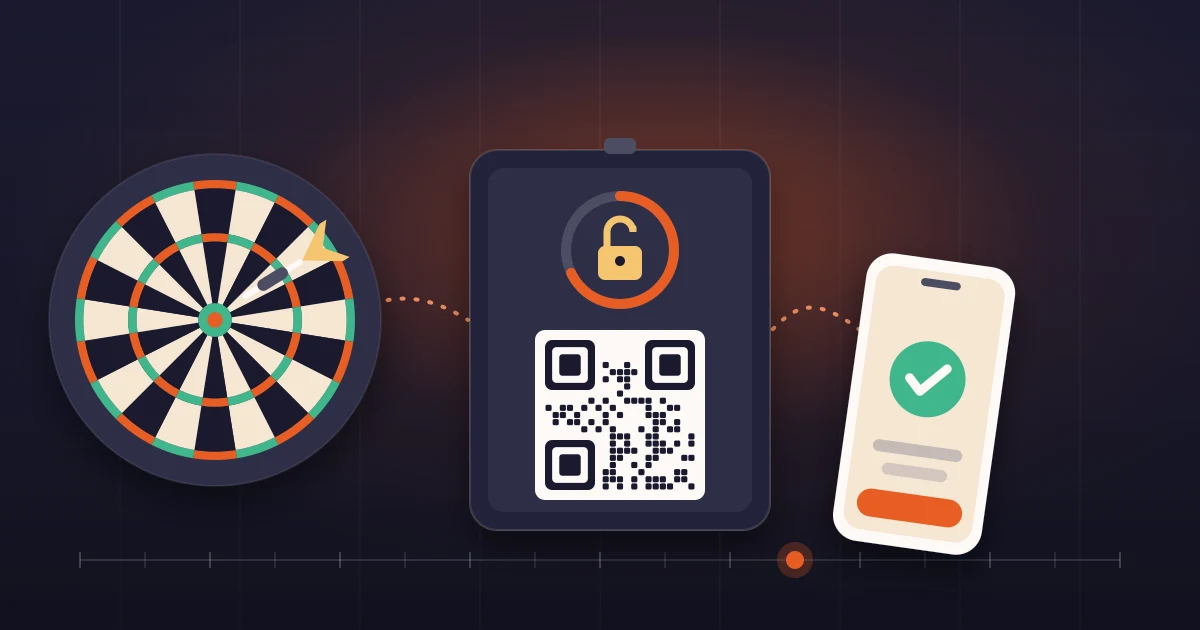
Every lane gets an Android tablet running the Tider Overlay app. The overlay draws a lock over whatever is on the screen — typically the darts system's own app — and takes every touch and every key press. While the lane is not paid for, the only thing a guest can interact with is a small orange pill in the corner: a QR code that books this lane.
The overlay is deliberately hard to get around. The back button does nothing, and if the tablet reboots or the app updates, it comes back locked. A tablet that has been knocked over, unplugged or fiddled with does not fail open into free games; it fails closed.
2. The guest scans the QR code
When the lane is free, the tablet shows the QR code. A guest scans it with their own phone and lands on a booking page for that exact lane — not a generic venue page where they have to find the right board, but "Darts lane 3, available now".
They choose how long they want to play, and pay on their phone — by card, or with the wallets people in the Nordics actually use, like Vipps and MobilePay. No app to install, no queue at the bar.
3. One person pays — the lane opens
The moment the booking is paid, the board comes alive. Two things happen at the same time:
- The tablet unlocks. The overlay lifts and the guests get the darts system's normal screen — game modes, player names, scoring — exactly as they would anywhere else.
- The darts system itself is switched on through its API, so the cameras start scoring.
Only one person in the group has to pay. Everyone else just picks up their darts. That matters more than it sounds: the fastest way to lose a group of six is to make them figure out who is paying for what before anyone can throw.
4. Time runs, the tablet counts down
While the session runs, the tablet knows exactly how long is left. It keeps checking with Tider — every 15 seconds — that the booking is still valid. If the booking is cancelled, the lane locks again.
The venue sets grace minutes either side of a booking, so a group is not cut off mid-leg the second their hour is up, and a group that pays for the next slot at the lane can start straight away.
5. Time is up — the lane locks itself
When the paid time ends, the darts system is switched off through its API and the overlay comes back down over the tablet. The lane goes back to showing the QR code, ready for the next group. Nobody had to walk over and do anything.
6. Staff stay in control, when they want to be
Self-service does not mean hands-off for good. Staff can open, lock or check any board from the admin, and open every board at once for an event or a tournament. At the tablet itself, a long press on the corner pill and a per-tablet staff PIN unlock it for a chosen length of time — useful for a regular, a demo or a lane that needs testing. Wrong PINs are rate-limited, so the PIN is not a game in itself.
7. It looks after itself
A standalone lane is only standalone if it does not need a technician every month. The tablets check in with Tider every five minutes: are they still paired to the right lane, is there a newer version of the app. Updates install themselves, silently, and only while the lane is locked — never in the middle of someone's game.
Setting a new tablet up is a matter of minutes: install the app, choose a PIN, type an eight-character pairing code into the Tider admin, tap the lane. From then on, the tablet belongs to that lane.
Why the overlay works with any interactive darts system
There are two halves to controlling a darts lane: the screen guests touch, and the system that scores. We built them as two separate layers on purpose.
The screen is system-independent. The overlay does not need to know anything about the app underneath it. It sits on top of the tablet's screen as a lock, and lifts when the lane is paid. Any darts system that runs its interface on an Android tablet can sit underneath it unchanged — no plugin, no modified app, no cooperation needed from the system's own software to make the lock work.
The scoring is controlled through the system's API. Locking the screen is not enough on its own; the cameras also need to stop scoring when nobody has paid. For that, Tider talks to the darts system's API to turn the board on and off. That is the only thing we need from a darts system: an API that can switch it on and off. No access to scores, no access to player stats — the game and its data stay in the darts system's own app, where players expect them.
Scolia is the first system connected this way and is live today. Adding another system means adding its on/off connection — the overlay, the QR booking, the payment flow, the countdown and the staff controls are all shared and do not change. If you build or run an interactive darts system with an API that can switch it on and off, it can be connected.
What this opens up for interactive darts system makers
Today, a darts system maker mostly sells hardware: a venue buys the rig, the company earns once, and the next sale has to be found from scratch. That model has a ceiling — every sale needs a venue with the capital, the confidence and the floor space to commit to it up front.
A board that can sell its own time changes the economics underneath that.
From selling boxes to earning from every game
When the board itself handles booking and payment, every session is a recorded, paid transaction. That makes it possible to put the hardware into a venue without selling it — and to earn from it for as long as people play on it.
- Leasing. Place the system in a venue for a fixed monthly fee. The venue gets interactive darts with no capital outlay; the maker gets predictable recurring revenue instead of a one-off sale.
- Revenue share. Place the system for free or at a low fee, and take an agreed share of what the lane earns. The better the location, the more the maker earns — which rewards putting boards where people actually play.
- Hybrids. A small base fee to cover the hardware, plus a share above a threshold. Low risk for the venue, a floor for the maker, upside for both.
Every placement has data behind it
Because every session is booked and paid through the lane, both sides see the same numbers: how many sessions, at what times, for how long, at what price. That is the foundation a revenue share needs. It is very hard to agree on "a percentage of what the board earns" when nobody can see what the board earns. With a booked, paid session behind every game, that question has an answer.
The same data tells a maker where to place the next board. A unit that is booked solid on Friday nights in one padel centre is a strong argument for a second unit there — or the same setup in the centre across town.
New kinds of locations
Most importantly, standalone operation opens up locations that were never realistic before. A darts system maker no longer only sells to darts bars. Any space with a wall, a power socket and people who spend an hour waiting is a potential placement:
- padel and tennis centres, where players wait between matches and linger after them,
- bowling alleys, climbing gyms and sports halls with lounge areas,
- hotels, hostels and conference venues with games rooms,
- cafés, student bars, workplaces and shared office spaces.
None of these places has someone standing by a dartboard. All of them can host one that runs itself.
What this opens up for venues
For the venue, the story is the mirror image: interactive darts without the big upfront bill.
No capital outlay, or much less of it
A full interactive darts setup — cameras, scoring hardware, screen or tablet, installation — is a real investment, especially for a venue whose main business is something else. A padel centre deciding between another court upgrade and a darts corner is rarely going to choose the darts corner if it has to pay for it all on day one.
With a lease or a revenue share, that decision becomes simple. The venue provides the space and the footfall; the board pays for itself out of the sessions played on it. If it is a hit, everybody earns. If it is not, the venue has not sunk a large sum into hardware that sits idle.
No staff time
The second cost of interactive darts is less visible but just as real: the attention it takes. A board that someone has to unlock, time and lock again is a small, constant tax on staff — and a tax that grows with every extra lane.
A standalone lane removes it. Guests scan, pay and play on their own. The board opens and closes on its own. Staff only step in when they want to: to open a lane for a regular, to run a tournament, or to open every board at once for a private event.
Revenue from space that earns nothing today
Most venues have corners that do not earn: a lounge, a waiting area, a wall next to the bar. A self-service darts lane turns that space into something guests pay to use — at times the venue chooses, at prices the venue sets, without adding a single shift.
And it adds to what the venue already sells. A group that books an hour of darts after padel stays longer, orders another round and comes back next week. Interactive darts is not just a revenue line of its own; it extends every visit around it.
Fewer disputes, no free games
Because the board only scores when a booking is paid, the familiar problems disappear on their own: the group that "just wanted to try it", the group that played an hour over their slot, the argument at the bar about who started when. The booking is the record, and the board follows it.
What a placement can look like in practice
Here is one way it could run — an illustrative example, not a fixed offer:
- A darts system maker installs two boards in a padel centre's lounge, each with a lane tablet running the Tider Overlay.
- The padel centre pays nothing up front. The two parties agree on a revenue share of what the lanes earn.
- Guests waiting for a court, or winding down after one, scan the QR code on a tablet, pay for 30 or 60 minutes on their phone and play. The board opens when they pay and locks when their time ends.
- Every session is a booking with a time, a length and a price, so both parties can see what the lanes earned and settle the revenue share on the same numbers.
- After a few months, the numbers show whether to add a third board, change the pricing at peak times, or move a board to where it gets more play.
Nobody in that chain had to stand next to a dartboard.
Getting started
If you run a venue — a padel centre, a bar, a sports hall or anywhere with space and footfall — and want interactive darts without the upfront investment, get in touch. We can tell you what a lane setup looks like for your space, and connect you with darts system partners who place boards on lease or revenue share.
If you make or distribute an interactive darts system and your system has an API that can switch it on and off, we would like to talk. Connecting a new system is the on/off connection only; everything else — the overlay, QR booking, payment, timing and staff controls — is ready today.
Either way, the idea is the same: a dartboard that sells its own time does not have to be bought by the venue it stands in. That is a better deal for the people who make the boards, for the venues that host them, and for the guests who just want to throw some darts.